|
|
|
|
OCCUPANT PROTECTION
includes seat belts, air bags, head restraints and door locks.
Seat Belt Observational Surveys
|
|
THE LAW
On January 18, 2010, legislation was signed into law requiring all occupants to buckle up, regardless of their seating position in a vehicle. The new law allows police to issue summonses to unbuckled back seat occupants, 18 years of age and older, when the vehicle they are riding in is stopped for another violation. The law is effective immediately.
As of December 1, 2001, the driver is responsible for ensuring that everyone up to the age of 18, no matter where are sitting, is wearing a seat belt. In addition, children up to 8 years old or 80 pounds must ride in a safety seat or booster seat in the rear seat of the vehicle. (see Child Passenger Safety)
Effective May 1, 2000, New Jersey's seat belt law became a Primary Law, which means the police can stop and issue a summons to drivers and passengers for not wearing their seat belts. Prior to this date, it was a Secondary Law, which meant police could only issue a seat belt citation after pulling you over for another motor vehicle violation.
New Jersey Law requires all passengers, who are at least 8 years of age but less than 18 years of age, and each driver and front seat passenger to wear seat belts.
New Jersey's first seat belt law was created in March of 1985.
|
|
SEAT BELTS
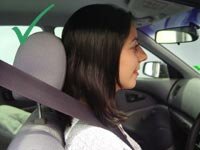
The vast majority of all injuries and deaths from traffic crashes are preventable. Seat belts are the most effective means of reducing deaths and serious injuries in traffic crashes. When lap and shoulder belts are used correctly, they reduce the risk of fatal injury of front seat passengers by 45 percent and the risk of moderate to critical injury by 50 percent.
Seat belts protect you by absorbing the crash force and keeping you in the vehicle. The must be worn snug to work effectively. Seventy-five percent people ejected from vehicles are killed. 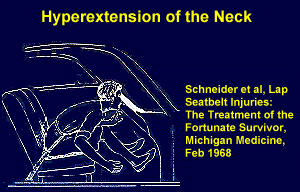
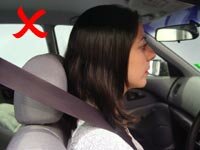
Never place a seat belt behind your back or under your arm. This reduces the 3 point system to a lap belt only and increases your chance of abdominal and spinal cord injuries. Front seat passengers also risk hitting their head on the dash or windshield.
Types of seat belts.
|
|
AIR BAGS
Are supplemental restraint systems that help protect the head and neck of the driver and front-seat passenger. Air bags are NOT a substitute for safety belts.
During a collision, seat belts help restrain the lower body and torso, while air bags absorb the crash energy and help keep the head and chest of front-seat passengers from hitting the interior of the vehicle.
Drivers should be at least 10 inches from the steering wheel. This allows the air bag to provide maximum protection and minimize friction from contact with the bag as it unfolds. Maintaining this distance may also minimize head and chest injuries in cars not equipped with air bags.
Drivers should also position their hands at the 10 and 2 o'clock positions on the steering wheel to provide the greatest protection by allowing the air bag to deploy unobstructed.
AIR BAG ON-OFF SWITCH - According to NHTSA, people who may be eligible for using on-off switches are drivers who cannot keep 10 inches from the steering wheel, people whose doctors say they have a medical condition that warrants turning off their air bags, and people who transport infants riding in rear-facing infant seats in front passenger seats or people who must transport children ages 1 to 12 in front passenger seats.
If an on-off switch is installed, individuals must be diligent to turn it off when permitting a child to ride in the front seat and on when an adult is in the vehicle.
|
|
HEAD RESTRAINTS
Many of us don't realize that head restraints are actually safety devices, designed to protect our head and neck in a crash. They are the key to reducing whiplash.
A head restraint should be positioned so that it cradles your head. Be sure to adjust it up or down as needed each time you drive.
|
|
WHY BUCKLE UP IN THE BACK SEAT
crash dummy video clip (.avi)
mom and son commercial (.mpg) (graphic)
Teenagers (.mpg)
Children and adults in back seats need to be restrained to not only protect themselves in a crash but also those in the front seat.
During a head-on collision, an unbelted passenger seated behind the driver or a front seat passenger becomes a "backseat bullet," slamming into the front seat occupant with their body.
This becomes a deadly situation. The odds of death are 3 times higher for the unbelted passenger and 2 times higher for the driver.
|
|
A CRASH
There are 3 collisions in a crash.
Vehicle Collision: This is the first collision, the vehicle begins to stop as soon as it collides with a stationary object.
As the vehicle slows, the front of the vehicle crushes, absorbing some of the energy of the crash.
Human Collision: At the moment of impact, people in the car are still traveling forward. Occupants will continue to move toward until they are stopped by something. For restrained occupants that is the seat belt. For unrestrained occupants that is usually the steering wheel, dashboard or front windshield.
Air bags slow the body's movement rather than stopping it abruptly reducing the likelihood of injury in the second collision.
Internal Collision: After impact, the brain and internal organs continue to move forward, or in the direction of travel, tearing corrective tissue or being bruised by the collision with the skeleton, including the skull.
Seat belts and air bags also reduce the severity of these types of injuries.
|
|
 SJTSA
SJTSA